
Monroe County Court Records After Arrest
After a Monroe County arrest, the first public facts often appear in the jail system. Corrections staff process the person through intake, secure property, enter data, take fingerprints, and take a booking photograph. That booking side matters, but it is not the same thing as the formal court case. The Monroe County Prosecuting Attorney reviews and authorizes felony, misdemeanor, and county-ordinance charges committed in Monroe County. Once that charging decision is made, the case record belongs to the court track.
The local path is specific. The Monroe County prosecution steps explain that misdemeanors begin with arraignment and a plea, while felonies start in District Court with rights advice, bond conditions, and a preliminary examination date. If probable cause is found or waived, the felony is bound over to Circuit Court, where the charging document is called an Information. For custody status and booking details, use Monroe County jail inmate records. For booking photos, use Monroe County jail mugshots. Court records after a jail arrest answer a different question: what charge is pending in court, and what stage has the case reached?
Find Monroe County Court Records After Arrest
Monroe County court records after arrest are searched through court sources, not through the jail roster alone. The 1st District Court page links Michigan's public case search and court calendar. The 38th Circuit Court page links Case Search and the Daily Docket. Both routes lead to MiCOURT Case Search, the statewide public portal used for many Michigan trial-court records.
- Open MiCOURT Case Search and select the Monroe County court that fits the case stage.
- Search by defendant name when no case number is known. Use a case number if it appears on a notice, ticket, complaint, or court document.
- Open the case record and review the charge list, hearing dates, court location, and current status.
- Compare the filed court charge to any jail-roster hold reason. Booking charges can change after prosecutor review.
The official court pages also matter when MiCOURT does not answer the whole question. Older files, sealed matters, recent filings not yet indexed, and clerk-specific records may require contact with District Court or Circuit Court. The District Court page lists 106 E First Street, Monroe, MI 48161 and phone 734-240-7075. The Circuit Court page should be used for felony cases after bindover, post-conviction matters, and many docket questions.
| Field | Type | Required | Notes |
|---|---|---|---|
| Court | Selection | Yes | Choose Monroe County 1st District Court or 38th Circuit Court when that route is available. |
| Case category | Selection | Varies | Criminal, traffic, civil, domestic, and probate availability depends on the court. |
| Party name | Text | Common path | Use the defendant name from the booking, citation, complaint, or notice. |
| Case number | Text | Alternate path | Use when known from jail paperwork, court notice, ticket, or complaint. |
| Date or docket | Date | Optional | Court calendar and daily docket pages can confirm scheduled hearings. |
Monroe County Court Case Screens
The statewide court portal is the main online doorway for Monroe County court records after a jail arrest. The MiCOURT Case Search page is the source shown here.
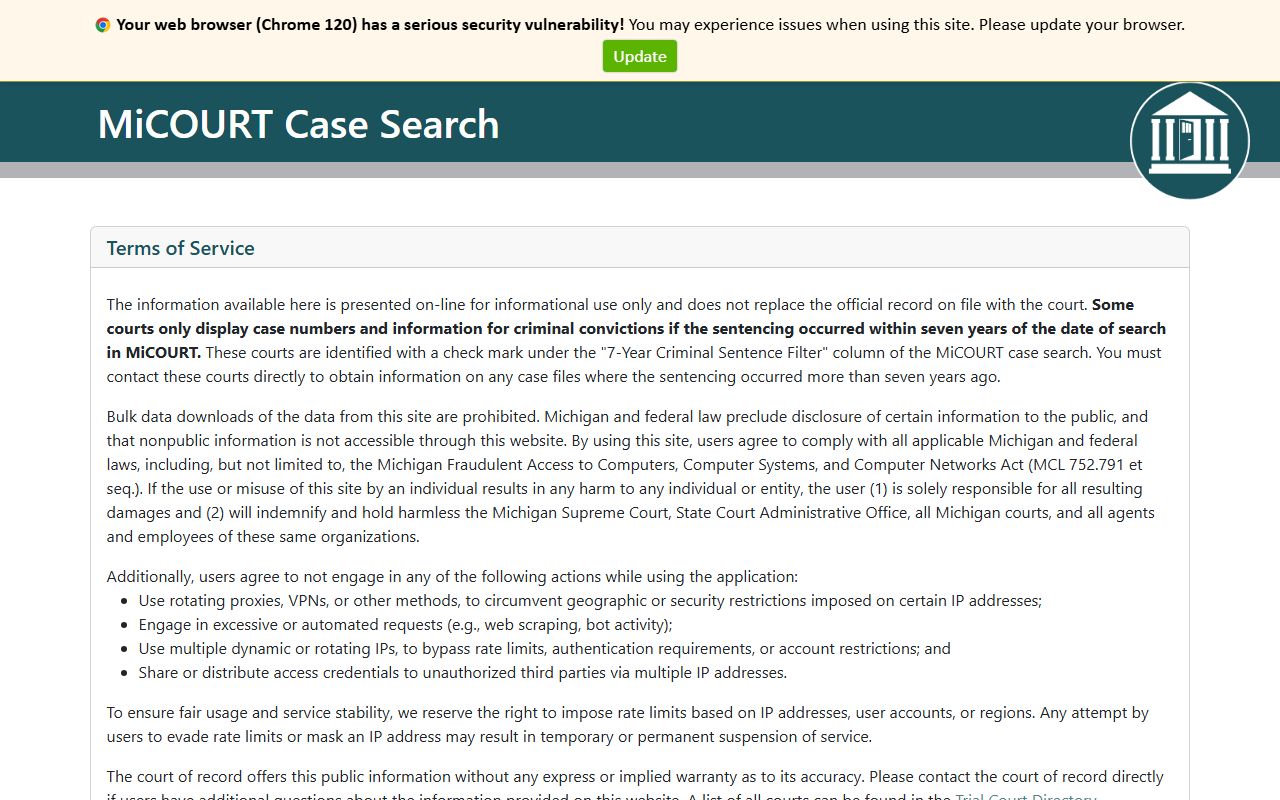
Use the court selection and party search carefully. A person can have a jail booking record before the court case is fully indexed, and a felony can move from District Court to Circuit Court after bindover.
Monroe County Arrest Charging Documents
The charge that appears in a jail entry is often an arresting-agency allegation or hold reason. The court case depends on a charging document. In Monroe County, the prosecutor is the bridge between jail booking and formal court records after a jail arrest. The Prosecuting Attorney page says the office reviews, authorizes, and prosecutes felony and misdemeanor criminal laws of Michigan and county ordinances committed in Monroe County.
| Document | Used For | How It Fits the Case |
|---|---|---|
| Complaint | Initial misdemeanor or felony filing | Starts the court case and states the charge being alleged. |
| Information | Felony case after bindover | Filed in Circuit Court after District Court probable cause steps. |
| Indictment | Grand-jury route when used | Formal accusation by grand jury, less common than complaint and information in routine local cases. |
The prosecutor source is local and useful for context. The Monroe County Prosecuting Attorney page identifies the office as the county's chief law-enforcement official for state-law and ordinance violations. The staff directory lists Prosecuting Attorney Jeffery A. Yorkey, 125 E Second Street, Monroe, MI 48161, phone 734-240-7600, witness hotline 734-240-7601, and weekday hours from 8 a.m. to noon and 1 p.m. to 5 p.m.
Monroe County Charge Status
Charge status is the reason court records after an arrest must be read with care. A booking can list a suspected offense, then the prosecutor may authorize a different charge, reduce it, add another count, dismiss it, or bind it over to Circuit Court. A charge is an accusation until there is a plea, verdict, or dismissal. The status shown in a court file should be read together with the hearing history and the latest docket entry.
| Status | What It Means | Monroe County Context |
|---|---|---|
| Pending | The charge is open and not finally resolved. | Check MiCOURT and the court docket for the next date. |
| Amended or reduced | The filed charge changed after review, plea talks, or court ruling. | Do not rely only on the jail roster's first charge label. |
| Dismissed | The charge was dropped by court action or prosecutor decision. | The arrest may still have separate record-clearing questions. |
| Bound over | A felony moved from District Court to Circuit Court. | The Circuit Court case and Information become the key records. |
| Convicted | The person was found guilty or pleaded guilty or no contest. | Sentencing, probation, jail, or MDOC transfer may follow. |
Bond After Monroe County Arrest
Bond is part of the court record after a Monroe County jail arrest because District Court handles first appearances and bond conditions. The prosecution steps state that felony arraignment includes advice of rights, a bond with conditions, and a preliminary examination date. Misdemeanor arraignment can include a guilty plea, not-guilty plea, or stand-mute plea, with not-guilty and stand-mute cases set for pretrial with the prosecutor.
| Bond Type | Plain Meaning | Record Check |
|---|---|---|
| Cash bond | Money paid to secure release and court appearance. | Confirm current amount with the jail or court before paying. |
| Surety bond | A bond posted through an approved bondsman or agency. | The Circuit Court bail bondsman page covers annual list applications. |
| Personal recognizance | Release on promise and conditions without full cash payment. | Read conditions in the court order, not just the roster. |
| No-bond hold | A court or agency hold prevents release by bond payment. | ICE, USMS, MDOC, probation, parole, or another court may be involved. |
The Monroe County bail bondsman page is not a general bond guide, but it confirms how the local approved list is handled. It also shows that bond questions can sit partly with the court clerk and partly with custody staff. Jail trust money may be used for bond, but a hold can still block release.
Warrants and Monroe County Arrest Records
A warrant can lead to a Monroe County jail arrest, then the court record may show the underlying case. The Zuercher public portal template supports warrant search fields such as name, race, sex, date issued, age or DOB, bond amount, and charge, but the county pages inspected did not publish a separate active-warrant list outside the portal. The safer path is to verify warrant details through the court or law-enforcement channel before taking action.
Bench warrants often come from missed court dates or violations of court orders. Arrest warrants authorize law enforcement to take a person into custody. Search warrants are different because they allow a search of a place or property and may not be public before execution or return. Michigan State Police ICHAT is a criminal-history tool, but the research notes that warrant information is not available through ICHAT.
Charges Versus Convictions
Monroe County court records after a jail arrest can show accusations long before any conviction exists. That distinction is not a fine point. A person can be arrested, booked, charged, released on bond, and later have a charge amended or dismissed. A conviction requires a guilty plea, no-contest plea accepted by the court, or a verdict after trial.
| Question | Charge | Conviction |
|---|---|---|
| Stage | Accusation filed in court. | Final finding or plea. |
| Proof level | Based on probable cause or charging review. | Based on plea or proof beyond a reasonable doubt. |
| Where it appears | MiCOURT, docket, complaint, or Information. | Judgment, sentence, ICHAT, OTIS when MDOC supervision applies. |
| Custody effect | May affect bond and jail status. | May lead to jail, probation, prison, fines, or other sentence. |
Important: A Monroe County jail arrest or filed charge is not proof of guilt. Verify the current court status before relying on a record.
Sealed and Expunged Monroe Records
Michigan record clearing can affect what appears in public court, criminal-history, and agency records. The research identifies MCL 764.26a, which addresses removal of certain arrest records from ICHAT when the prosecutor agrees or charges are not pursued. It also identifies MCL 780.621, the adult conviction set-aside statute. These laws do not mean every local jail record, booking photo, third-party copy, or court index vanishes at the same time.
| Record Action | What It Can Do | What It Does Not Promise |
|---|---|---|
| Sealed or nonpublic court record | Restricts ordinary public access to the court file. | Does not prove that every agency copy has been deleted. |
| Arrest-record removal from ICHAT | Can remove qualifying arrest data from state criminal-history display. | Does not erase all jail, police, or court records by itself. |
| Conviction set-aside | Can make an eligible conviction nonpublic under Michigan law. | Does not rewrite the original custody event without proper orders. |
FOIA and Court Clerk Records
Not every record after an arrest is obtained the same way. Court records should be requested from the court clerk when the item is a docket, complaint, order, judgment, or hearing record. Sheriff and jail records, such as arrest reports or booking records not shown online, generally route through the Monroe County Sheriff's Office Records Division or FOIA process.
The Sheriff's Records Division page says the division maintains criminal records for the department and is open seven days a week, 24 hours a day. The Monroe County FOIA page and county procedures say written requests must describe the record, and the county normally responds within five business days, with a possible 10-business-day extension. Sheriff FOIA requests may be emailed to foia_sheriff@monroemi.org. Prosecutor FOIA routing uses the prosecutor FOIA coordinator address at 125 East Second Street.
Important: Court, jail, criminal-history, and consumer-reporting uses are separate. Do not use casual public lookup results for FCRA-covered decisions.